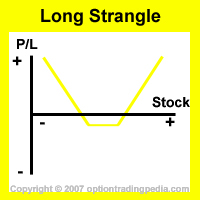
Profit Calculation of Strangle: % Return = [Exit Price of Underlying Asset - (Strike Price + Net debit)*] ÷ Net Debit
* : If the underlying asset is down, use (Strike Price - Net debit)
Risk / Reward of Strangle: Maximum Profit: UnLimited
Maximum Loss: Limited
Net Debit Paid
Break Even Point of Strangle:
There are 2 break even points to a straddle. One breakeven point if the underlying asset goes up (Upper Breakeven), and one breakeven
point if the underlying asset goes down (Lower Breakeven).
Upper BEP: Strike Price + Net Debit Paid
Lower BEP: Strike Price - Net Debit Paid
Advantages Of Strangle :
Able to profit no matter if the underlying asset goes up or down.
Lower net debit than the Long Straddle strategy.
Higher profit in % than a straddle on the same move in the underlying stock, provided that breakeven point has been exceeded.
Since both options are OTM, price decay on the options is not as rapid as they are with the Long Straddle.
Unlimited profit if the underlying asset continues to move in one direction.
Saves time from having to analyse if a stock will go up or down ahead of major news releases.
Loss is limited to the debit paid.
If volatility is low at the time of purchase and volatility rises, both options could profit even without an appreciable change in the stock price.
No need to buy the underlying asset which is good for investors with small funds.
Disadvantages Of Strangle:
There will be more commissions involved than simply buying call or put options.
You can lose more money if the underlying asset stayed stagnant or within the breakeven range than if you simply bought a call or put option.
If the underlying asset rises above the strike price or falls below the strike price but remains below the upper break even or above the lower break even you will still incur a loss on the position.
If volatility falls for both or either option, the position could lose with or without a price swing in the underlying asset.
Important Disclaimer:
Options involve risk and are not suitable for all investors.
Data and information is provided for informational purposes only, and is not intended for trading purposes. Neither www.optiontradingpedia.com, mastersoequity.com nor any of its data or content providers shall be liable for any errors, omissions, or delays in the content, or for any actions taken in reliance thereon. Data is deemed accurate but is not warranted or guaranteed. optiontradinpedia.com and mastersoequity.com are not a registered broker-dealer and does not endorse or recommend the services of any brokerage company. The brokerage company you select is solely responsible for its services to you. By accessing, viewing, or using this site in any way, you agree to be bound by the above conditions and disclaimers found on this site.
Copyright Warning:
All contents and information presented here in www.optiontradingpedia.com are property of www.Optiontradingpedia.com and are not to be
copied, redistributed or downloaded in any ways unless in accordance with our
quoting policy.
We have a comprehensive system to detect
plagiarism and will take legal action against any individuals, websites or companies involved. We Take Our Copyright VERY Seriously!